

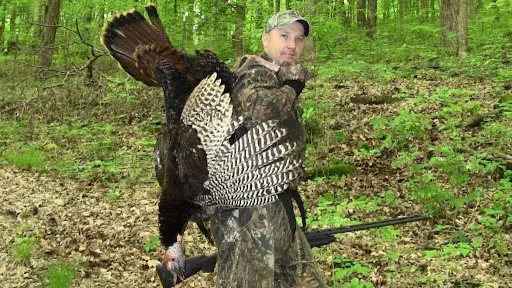
The alarm goes off at 4:15. It’s still cold outside. The kind of April chill that feels like a personal insult from a season that should know better by now. You pull on your base layer in the dark, stuff a granola bar in your vest pocket, and walk out to a truck that’s been sitting in 38 degrees all night.
There’s something uniquely electric about the pre-dawn ritual of spring turkey hunting. Lining up your sight as the sun is slowly rising is, genuinely, one of the few unrepeatable experiences available to a man in this country today.
Maybe you have had that 150 yard shot already. Maybe you haven’t. Either way, this blog is the perfect piece to guide you through Turkey season.
When to Go and Where to Be Standing
Spring turkey season runs March through May across most of the country. In the Southeast, the true bread basket of turkey hunting, the season opens in late March. But it’s in late April and May when prime Turkey hunting takes place in the South across states like Georgia, Missispi, Alabama and the rest of the SEC heartland.
In the Appalachian corridor, the seasons run later and the terrain is different. Flat ground tactics don’t work in the hills. Turkeys in the Appalachian mountains use ridge systems like highways. It is a different kind of hunt, but enjoyable nonetheless.
The Midwest, particularly Missouri, Illinois, Iowa, and Kansas, opens in mid-April and runs into May. These are some of the best public land states for turkeys. Here you will find dense populations, aggressive birds, and enough Wildlife management area to partake in a proper hunt.
Texas is its own conversation: the Rio Grande turkey is a different bird. While it can be found in 15 states, no state has the density Texas has when it comes to the Rio Grande Turkey, almost half a million of them. These birds are particularly call-shy, they’re more likely to hang up at 80 yards staring at your decoy.
What the Guy Who Caps Out Every Year Does Differently
He scouts. Not on opening morning but the week before, and the week before that, and again the night before season opens. Preparation really does matter.
Learning to “put the birds to bed” will pay dividends. In the evening, get to high ground or a field edge and watch where toms (male turkeys) fly up to roost. Specifically listen for the wingbeats, and for the roost gobble they’ll sometimes throw out just after they hit the limb. Mark it on your phone. That bird will be within 150 yards of that tree when the sun comes up the next morning. You will already be set up 100 yards away with a clean sight.
If they aren’t talking naturally, use a locator call, a predatory noise like an owl hoot or crow call, at dusk to shock a gobble out of them. Loud, sudden sounds can trigger involuntary gobbles when done at the right moment.
Taking the time to research the terrain before you hunt is crucial. Turkey tracks and droppings are useful confirmation, but the bird’s movement pattern is dictated by terrain first. You need to have a general idea of where open areas are, and you’ll want to set yourself up to give turkeys a downhill approach. Toms strut in open areas adjacent to cover, travel creek bottoms, and use ridgelines as travel corridors.
Look for wing-drag marks in soft dirt, the sweeping lines a tom leaves on both sides of his tracks when he’s in full strut. Fresh scratchings in leaf litter mean feeding activity. These aren’t glamorous details but they’re the difference between a guy who knows what he’s doing and understands where turkeys actually are and a guy who’s a beginner, hunting where turkeys theoretically could be.
The Calling Conversation Nobody Wins
Even the most naturally talented hunter has to practice calls. In most cases it takes at least one whole season to get good at calling. Learn the mouth call and accept it will take time.
If you are in a spot where you can’t mouth call or don’t feel confident enough to do it without possibly scaring birds away, then go get a box call. The box call, a Lynch Fool Proof or a Woodhaven, are both great options. They will carry in wind and are easier to master.
The slate call, a Woodhaven Cherry for instance, produces some of the most realistic friction sounds you’ll find, and it excels at soft purrs and clucks that close-in birds respond to. But neither of those gets both hands free when a turkey is at 60 yards closing, and that matters. More importantly, a slate call is harder to master.
For calls in general, here’s a good rule of thumb: call aggressively to a bird that’s fired up and moving. Go subtle with softer clucks when it’s hung up close. If he goes silent and doesn’t appear, wait fifteen minutes before calling again. Patience in heightened moments is a critical part of mastering the hunt.
What You Need vs. What They’ll Try to Sell You
A 12-gauge shotgun patterns well and kills cleanly inside 40 yards, which is where Turkey hunting ideally happens. The most popular options nowadays are the Mossberg 500, Benelli Nova, and Browning Maxus.
Pattern your gun with the load you’re hunting. For new hunters, that just means testing the shot beforehand at a range with the ammo you will be using to make sure you understand what kind of shot you are shooting.
Bow hunting turkeys is an entirely different game. Respect it, but know what you’re signing up for: dramatically reduced margin for error, a need for a blind (external camouflage), and a commitment to pass on marginal shots that a shotgunner would take every time.
The rule is simple for camo: cover everything. Turkey’s eyesight is not a myth or an exaggeration, they can see almost three times as well as a human.
Bare hands, an uncovered face, a pale forearm; any and all of it gets you spotted right away. Sitka and First Lite make excellent turkey-specific stuff, but Mossy Oak Obsession in a $40 set from Bass Pro will work just as well if you sit still. The camo doesn’t kill turkeys. Stillness kills turkeys. Wear whatever keeps you covered and doesn’t make noise when you move.
For footwear: boots that are waterproof, have ankle support and are quiet. Don’t show up in athletic shoes and don’t spend $400 on boots for three weeks of walking.
For your decoys: one hen, one strutter (big male) or jake (smaller male). Avian-X makes the most realistic foam decoys on the market and it shows when a tom at 80 yards locks his eyes on it. Some hunters go decoy-free in pressured areas where birds have learned to hang up at the sight of plastic. It all depends on the situation. In open fields, a decoy is almost mandatory. In the woods you don’t really need it.
The one thing the sporting goods counter will try to sell you that you absolutely do not need is a blind. Unless you’re bowhunting or hunting with a kid, a blind kills your ability to move when a bird hangs up. Set up against a wide tree trunk and learn to sit still.
Inside 40 Yards: The Part That Matters Most
Turkey always stop. Sometimes it’s at 80 yards, sometimes it’s 25. He’ll stand there, looking, listening, deciding. This is where hunters move and blow the whole thing. Do not shift your gun, do not scratch your face, do not exhale visibly. You have been freezing in the dark since 5am for this moment and it costs nothing to hold still for two more minutes.
The shot should be targeted to the head and neck. At 35 yards with a good pattern this is not a difficult shot. At 50 it starts to get marginal with standard loads as the pellets won’t stay together as well. At 60 it’s a wounding shot more than a killing shot, and every bird you don’t kill clean is a bird you track and frequently don’t recover. That last part is the most critical: be an ethical hunter. Don’t go out just to pain an animal, finish the kill.
After the shot you are going to want to jump to see the damage. It’s important you don’t rush in immediately. If the bird is down but not dead and you move too fast, you’ll watch him run 200 yards into a creek. Wait sixty seconds, then approach from behind and put your boot on his legs before you touch anything else.
Field dressing in the turkey world is optional and depends on how long you’re getting him home. Most guys keep the breast intact, remove it at home, and freeze the rest or make stock from the carcass. The thighs and legs braise beautifully, cook them low in a Dutch oven with chicken stock, garlic, and thyme until they fall off the bone. The breast gets cut into cutlets, pounded thin, breaded with seasoned panko, and fried in a cast iron skillet. If you’ve never eaten a turkey you killed, you’ve never actually finished the hunt.