

Somewhere on the internet right now a streamer is hitting the buy button on a slot for the fortieth time and calling it research. Slotester Lab does the same thing with a script, a fixed bet, a ledger's worth of discipline and no audience to perform for. Since September 2026 its rig has bought 6,550 slot bonuses and logged 1,720,000 ordinary rounds on the studios' official demo servers, and it publishes the whole record, checksums included. Here is what that looks like for a cowboy-themed Pragmatic Play release with a hundred bought tickets in its file.
A lab, not a stream
Slotester is a slot testing site at slotester.com, run under the name Slotester Lab rather than under invented reviewer personas. Its test rig is a Python program that speaks to a game's demo server exactly as the client would: it starts a session, places thousands of spins at 2.00 demo units and records every server response, including each cascade, respin and free spin inside a round. When a game offers a buy button, the rig presses it a predetermined number of times during that session, and a real Chrome window later opens the same build for screenshots and a bonus video. A human editor checks every number in the draft against the log before anything is published.
The lab's own rules are short. Studios do not pay for tests and cannot commission them. Numbers are never edited; an odd run is re-run or explained, never smoothed. Every review carries a confidence interval and the sentence that a different session can land elsewhere. And the data is open while the rig stays closed, the argument being that a rig published in full is a rig that studios could tune against.
The buy button, priced
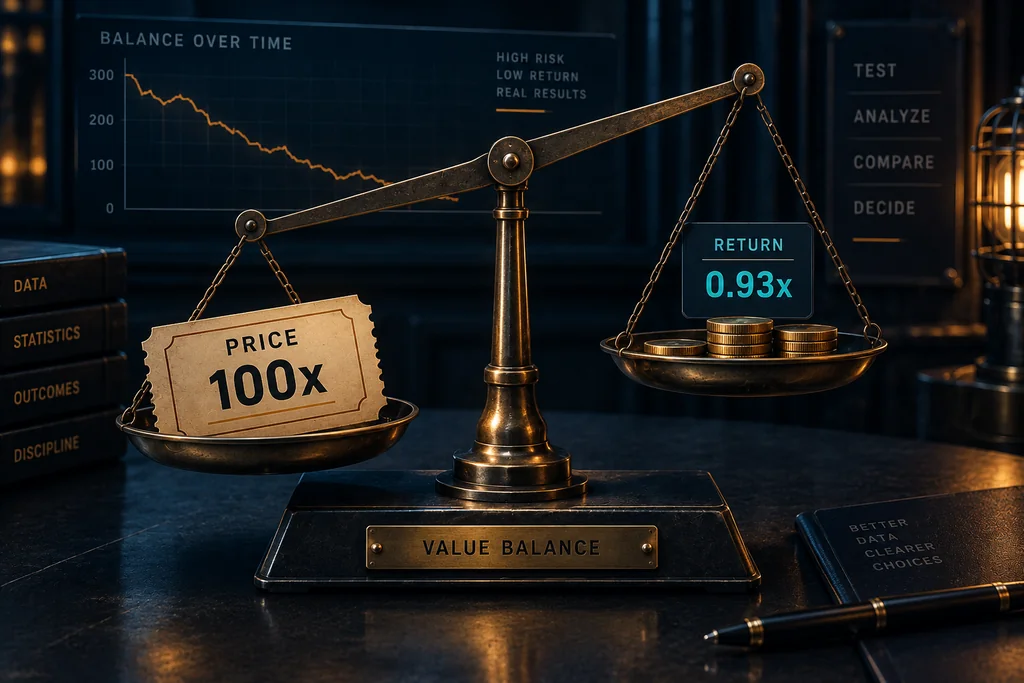
A bonus buy is a ticket with a price and a return, and the lab reports it that way. Complete purchased-round payouts are divided by the full ticket price, and the mean, the median and the share of tickets below price are computed from settled journal amounts. Across all tests to date the average bought feature returned 0.93 times its price. That figure hides an enormous spread between games, which is why each review has a bonus buy section of its own, and why the ticket in the game below did rather worse than average.
The scale of the file matters here. Eighty-one of the 104 games tested sell a feature, and the 6,550 purchases logged so far are enough to show that a printed purchase RTP, where a game prints one, guarantees nothing for a batch of fifty tickets. The same catalog holds a game whose tickets returned 1.39 times their price and, a few rows away, a run where they returned 0.62.
The case file: Wild West Gold Megaways
The lab's review of Wild West Gold Megaways RTP pools two runs, logged on 7 and 27 September 2026, of 10,000 spins and 50 purchases each, all at USD 2.00 on the official Pragmatic Play demo server. The game plays on six reels that show two to seven symbols each, up to 117,649 ways, and its declared return is 96.44% for ordinary play, 96.41% with the ante bet and 96.45% for purchases. The win cap is 5,000 times the stake.
| Run | Measured return | 95% interval | Natural features | Buys, mean return | Balance at close |
|---|---|---|---|---|---|
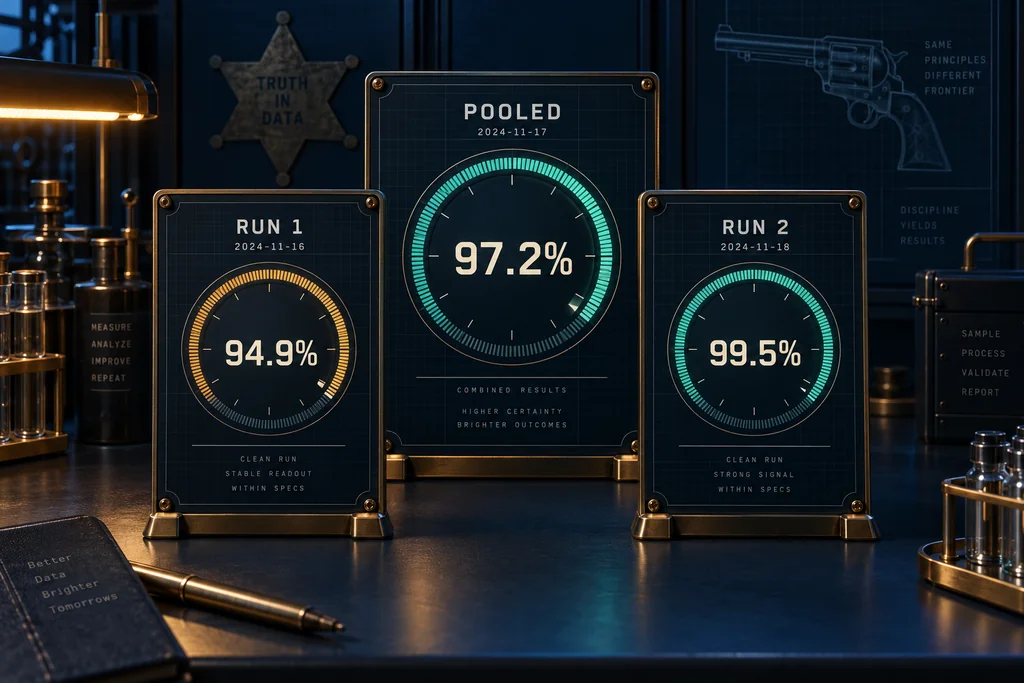
| 1, 2026-09-07 | 94.94% | 72.9% to 117.0% | 26, one per 385 spins | 0.6201x of price | 506 stakes down |
| 2, 2026-09-27 | 99.52% | 81.8% to 117.3% | 34, one per 294 spins | 0.933x of price | 48 stakes down |
| Pooled | 97.23% | 83.1% to 111.4% | 60, 3.0 bHz | 0.7765x of price | 555 stakes down |
The pooled return now sits within a point of the printed 96.44%, which the lab reports without treating it as a verdict on fairness. A hit landed on 21.4% and 22.24% of spins in the two runs with a median paying spin of one stake, 78.2% of rounds paid nothing, and the two sessions produced 39 dry stretches of at least 20 spins, two of them exactly 30 long.
One hundred tickets, one ledger
Entry to the feature costs 100 stakes, USD 200 at the lab's bet, and starts it with three to six scatters on the triggering spin. The hundred tickets cost USD 20,000 and returned USD 15,530.90, a return of 0.7765 times the price, or 77.65%, with an approximate 95% interval of 59% to 96%. The median ticket paid USD 89.55, less than half its price. Eighty of the hundred lost money, 58 returned under half, only 20 covered their price and eight paid double or more. The two tickets above 5x both came in the second run, purchase 25 at 5.97x and purchase 18 at 5.245x; the best ticket of the first run managed 3.06x. Take the single best ticket out and the other 99 averaged 0.7241x.
The lab's summary: the game pays its features in bursts and has yet to pay for its tickets. That describes two recorded batches, not a rule, and the second, at 0.933x, was a good deal kinder than the first.
Why the feature pays in bursts
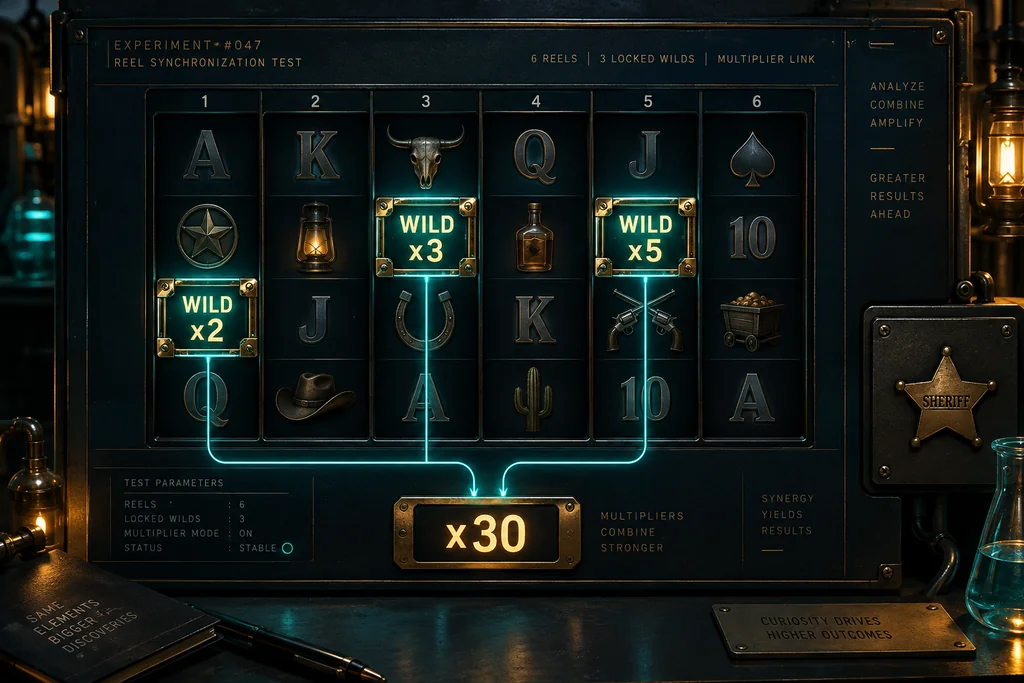
The explanation is in the rules, which the lab captures as seven screens from the game itself. Nothing on the paytable is large by itself: the sheriff, the top symbol, pays one stake for six of a kind. The size comes from wilds, which land on the four middle reels with a multiplier of x2, x3 or x5 attached, and when several wilds sit in the same way their multipliers are multiplied together, so two x5 wilds turn a 0.3x line into 7.5x. Inside the free spins every wild that lands becomes sticky, keeps its multiplier and stays on its reel until the round ends. A screen that fills with multiplier wilds pays hundreds of stakes; a screen that does not pays pocket change.
The log shows exactly that shape. Sixty natural features over the two runs averaged 89.7x from the free spins alone, but the median was 37.025x, sixteen cleared 100x, nineteen stayed under 20x and eleven under 10x. The three largest rounds of the whole test were all features: 683.7x on round 2711 and 621.8x on round 934 of the first run, 564.1x on round 7468 of the second. Remove round 2711 and the other 19,999 spins returned 93.81%. The largest ordinary spin was 362.5x on round 6823, a single evaluation built on multiplied wilds, one of seven plain rounds above 100x in 20,000.
The feature starts at seven spins and has no scatter retrigger; extra spins come from sheriff badges, overlays that add spins when two or more land at once, two badges for two spins and up to six for six. Twenty-one of the 60 natural features stretched past seven spins, twenty to nine and one each to ten and eleven, and 27 of the 100 bought rounds did the same.
Dry streaks and bankrolls
Every review carries a risk profile that answers a blunt question: how long would 50, 100 or 200 stakes have survived? In the first Wild West Gold Megaways run the answers were spins 140, 246 and 455. In the second, 62, 251 and 1,247. The deepest fall from a running peak across the two runs in sequence was 2,180 stakes, and the balance bottomed 1,348 stakes below its start. The first run had a peak of 831 stakes up at spin 3308, lifted there by the two 600x features, and spent the remaining 6,700 spins giving it back.
Site-wide the story repeats. Of the 104 games tested, only one never exhausted a 50-stake bankroll, two never exhausted 100 and six never exhausted 200, and the longest dry streak recorded anywhere is 73 spins. The lab's standing advice next to every table is that another session might go broke sooner or never, and that the figures are a measured example rather than a rule.
Checking the lab's homework
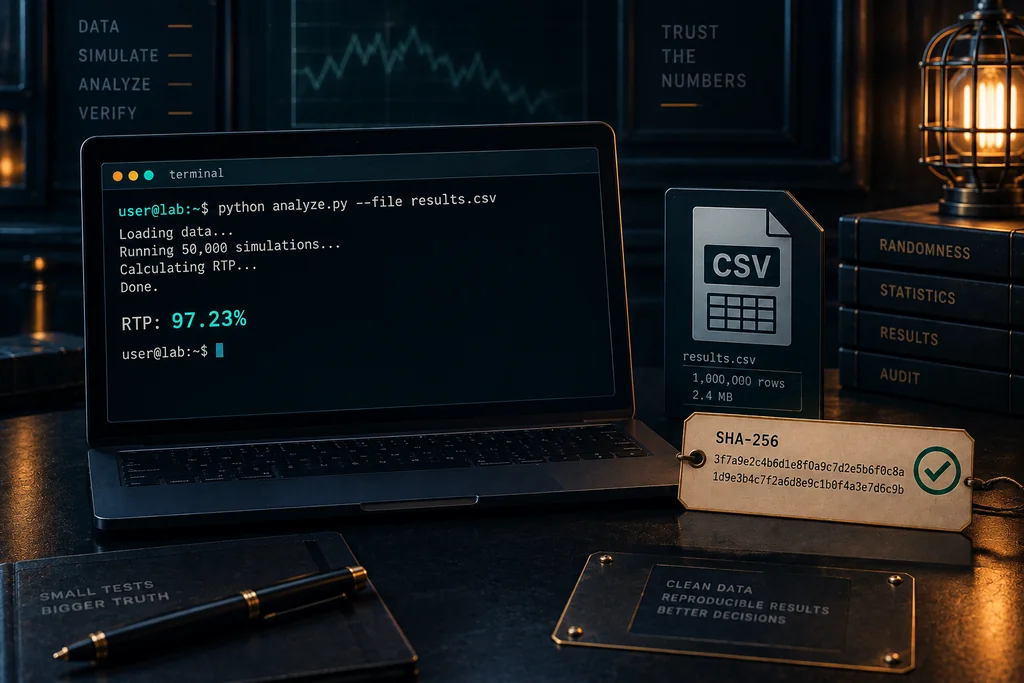
None of the above has to be taken on trust. Each run in a review's test record offers a readable spin log, a CSV of the ordinary rounds and compressed journals covering rounds, purchases and the raw server exchange, every file paired with a SHA-256 checksum that a button on the page copies to the clipboard. The How we test page publishes every formula, from measured return to the bankroll survival table, and a one-line Python command that recomputes the return from the CSV. Joining the two Wild West Gold Megaways files reproduces the pooled 97.23%.
The lab also runs checks before a page goes live: the logged win of every round must equal the change in server balance plus the stake, free-spin totals must match the server's own end-of-feature fields, every figure in the text is traced back to the log, and every fresh review is checked against the existing ones for recycled sentences. Only then does the editor read it.
Play it like a lab, not like a stream
- The demo is free and the math is the same. The demo embedded in each review loads from the studio's server and needs no sign-up; the lab's numbers describe that build, not any casino's version of it.
- A ticket is a price, not a shortcut. In this file 80 of 100 tickets lost money; the ledger, not the highlight reel, is the record.
- Set a budget in stakes before the first spin. The risk profile shows what 50, 100 and 200 stakes lived through, which is a better planning tool than the 5,000x cap in the specs.
- Gambling is entertainment with a cost. A responsible gambling link sits beside every demo on Slotester, and anyone who cannot keep to a limit should not be playing at all.
Frequently asked questions
Who runs Slotester Lab?
The site publishes under one name with one responsible editor who approves each review and handles corrections sent to the lab's address; there are no fictional experts.
How does the site make money?
Only through partner casino links shown under a game's demo and marked as sponsored. The lab states that no partner can move a measurement, a verdict or the order of its rankings.
Is the rig open source?
It is not. The logs are public and can be verified with checksums, while the software behind them stays private.
Will Wild West Gold Megaways be retested?
Retests happen over time as fresh sessions, and each run is kept on the page, so the pooled figure and the ticket ledger can change as runs accumulate.