

In 2026, 61 percent of Somalia’s population lived within LTE or WiMAX coverage, yet only 27.9 percent of people were recorded as internet users. That gap is more useful to a product designer than a headline about 5G. It says that a signal can exist without turning into regular online use, and that a service which looks fine on an office connection may still fail in the conditions that matter.
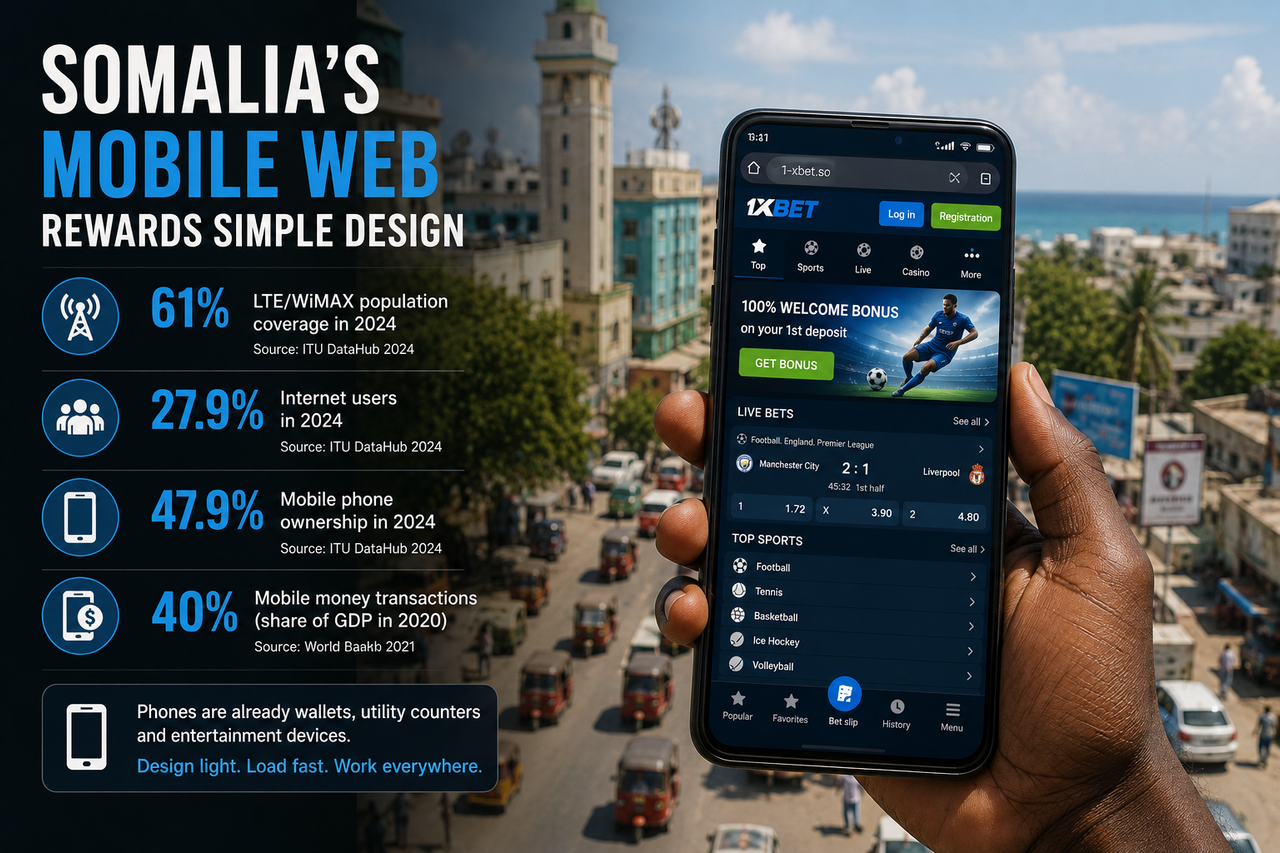
The same ITU dataset puts 3G population coverage at 83 percent, mobile phone ownership at 47.9 percent, and active mobile broadband subscriptions at 13 per 100 people. Those figures describe a country where access is expanding, but where device ownership, cost, coverage and actual use do not move in lockstep. A designer who treats mobile coverage as a synonym for comfortable mobile browsing will build the wrong thing. Fast.
Why coverage numbers mislead
The ITU DataHub for Somalia is useful because it separates network reach from actual behaviour. In 2024, reported internet use stood at 27.9 percent, well below the 61 percent LTE or WiMAX coverage figure. Somalia’s population on the same ITU dashboard is listed at roughly 19.7 million for 2025, which makes the usage gap too large to dismiss as a technical footnote.
For publishers and product teams, this affects ordinary decisions. A news homepage, booking form, payment screen or sports page has to work for people who may have coverage but still face limits caused by data prices, device age or inconsistent network quality.
There is another clue in payments. A World Bank digital economy assessment reported that recorded mobile money transactions in Somalia in 2020 were equivalent to 40 percent of GDP. The Central Bank of Somalia also introduced its Mobile Money Services Regulation in 2020, placing these services inside a formal regulatory framework.
Phones are already used for tasks that many other markets still push toward bank cards, desktop banking or cash offices.
This is where foreign product teams often get the priority wrong. They assume a richer interface signals a better service. In Somalia, the better service may simply be the one that asks less of the phone.
Old interfaces still win
Look at ZAAD, the mobile money service operated by Telesom. The service dates back to June 2009, and USSD codes remain part of the way customers can use it. A dollar transfer can be initiated through a short numeric command rather than a graphically heavy interface.
Those codes look dated beside a polished smartphone app. They also explain why USSD has survived. It is direct, familiar to repeat users and does not require a large page to load before the user can complete a basic task.
Hormuud’s EVC Plus makes a similar point from another part of Somalia. Users can pay bills, purchase airtime, transfer money and handle everyday transactions through a phone. Merchant services extend the same system into shops, deliveries and supplier payments.
A phone, then, is already a wallet and utility counter before the browser is opened.
I would take that seriously when designing any consumer site for the market. A five-megabyte hero image that arrives before the useful part of a page is not decoration on a weak connection. It is a queue.
The same problem appears with autoplay video, several tracking scripts, oversized web fonts and consent boxes that cover half of a 360-pixel display. Individually, each decision may appear harmless. Put them together on an inexpensive Android phone over a fluctuating connection and the site becomes harder to use for no good reason.
Entertainment has the same technical limits
News, music, travel, sports and gaming sites compete for the same minutes of attention and the same mobile data. A football fan checking a match in the evening is not thinking about a site’s design system. He wants the score, event, price or account screen to appear before the connection changes again.
That makes betting platforms a useful case study even for people who do not work in betting. A service such as 1xBet operates inside the same mobile conditions: useful pages need to remain readable, tappable and stable after a reconnect, and light enough to reload on an ordinary phone without wasting time or data.
Put the same page on a large desktop monitor connected through fibre and many poor decisions disappear from view.
The contrarian view is that native apps do not automatically fix this problem. They may store some files on the device and preserve session information, reducing repeated loading. They can also become large, require frequent updates, lose state after an interruption or behave badly on older versions of Android.
For an occasional visitor, a light mobile website may be the better product. A frequent user may save time with an installed app. The useful format depends on what the person actually does rather than which option looks newer in a presentation.
Local payment habits also affect expectations. Someone accustomed to completing a mobile money action through a short USSD command has little patience for a digital service that requires six screens before reaching the requested function.
This principle carries well beyond payments. A tourism site should expose transport details early. A news article should not hide its first paragraph beneath an advertisement and a registration banner. A sports service should put the current event ahead of decorative content.
Testing for the connection people actually have
The useful test bench is cheap. Start with a 360-pixel viewport, throttle the connection to a 3G profile and open the page from a fresh session with cached files disabled. Then switch the connection off for twenty seconds in the middle of a form or account action.
Restore it. Watch what happens.
Does the page recover, or does the user have to begin again? Does a button remain active while nothing is happening? Is there a readable error message, or only a frozen loading icon?
Repeat the test with images blocked. If the page becomes difficult to understand, too much information has been placed inside graphics. Try the main action with one hand. Check the first screen before scrolling, the size of the tap targets and what happens when a translated label is longer than the original English text.
There is a limit to this argument. Somalia is not one device profile or one network speed. Telesom advertises fibre services, eSIM products, mobile data packages and 5G equipment, while the national communications regulator allocates spectrum for newer mobile technologies. Users in major urban areas with recent phones can reasonably expect richer media and faster interactions.
Designing every Somali service as if the country were permanently stuck on a basic handset would be lazy. Still, the difference between coverage and actual internet use makes one point hard to ignore: a connection existing on a coverage map does not mean every visitor has a comfortable browsing session.
A page that behaves well in imperfect conditions will behave well on fibre too. The reverse is far less certain.
Open the page on a 360-pixel screen, throttle it to 3G, cut the connection for twenty seconds, and see what breaks.